
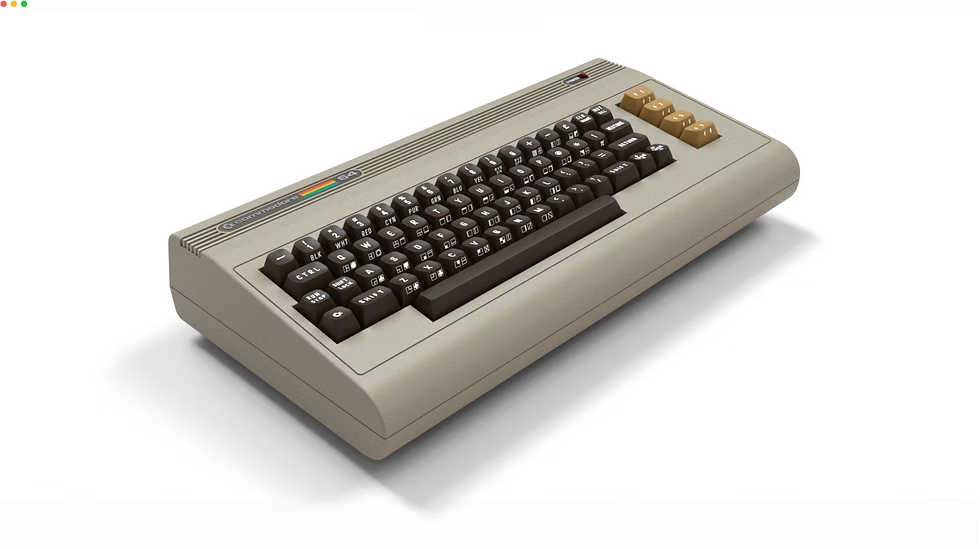
Blending retro aesthetics with sleek modern functionality.
The Commodore 64. An artefact. A ghost from the 1980s that, apparently, we just can’t shake loose. Thirty years. Thirty years, and here it is: the first official C64 since the Berlin Wall came down and we all optimistically decided we were moving into a sleek, sensible future. Instead, we got the internet, social media, and this—a brand new, meticulously engineered clone of a computer that used to take five minutes to load a game about a camel fighting aliens. It’s called the BASIC Beige. And that name, that colour, is everything. It’s the beige of a doctor’s waiting room, the beige of office partitioning, the beige of institutional inevitability. It’s the visual equivalent of a shrug.
The Problem with Resurrection
This isn’t just a replica; it’s a resurrection. They haven’t cobbled together some shabby emulator running on a cheap chip. No. They’ve gone the whole hog and recreated the original motherboard logic using Field-Programmable Gate Array (FPGA) hardware. It’s not the actual C64, but it thinks it is. It runs the software, it replicates the quirks, it even makes the correct, slightly tinny sound. It’s a perfect copy of the past, presented in 1080p via HDMI.
And that’s the terrifying part, isn’t it?
We’re not just engaging with the past; we’re trying to perfect it. We’re taking the flawed, sticky, slow, beautiful mess that was the original C64 experience—the genuine frustration, the sheer effort required to play Bruce Lee—and we’ve sanitised it.
- It’s Too Fast. The drive emulation means games load in seconds. Gone is the slow, grinding horror of the floppy disk drive light blinking, blinking, blinking, holding your childhood joy in its electromechanical hands. We’ve removed the friction. And friction, often, is where the memory actually lives. Now it’s just instant gratification wrapped in a beige shell. It’s like injecting nostalgia straight into the frontal lobe.
- It’s Too Clean. The keyboard is a modern mechanical job—clicky, tactile, responsive. Not the spongy, cheap, slightly unreliable thing we all remember. It’s a brilliant keyboard for a modern machine. But the original C64 keyboard felt like it was designed by a disgruntled accountant on a Friday afternoon. This new one is better. And therefore, it’s a lie. It promises the past, but delivers optimal performance. Which is precisely the opposite of what the past was actually like.
The Ultimate Pointlessness
So, what is it, this machine?
It’s an expensive, high-definition comfort blanket. It’s an admission that the relentless march of technological “progress” hasn’t actually made us any happier. We’ve got supercomputers in our pockets that connect us to the entirety of human knowledge, and what we actually want to do is sit in front of a giant screen, playing games from 1984 on a machine that perfectly replicates the flawed logic of its ancestor.
It’s the ultimate feedback loop: we use the pinnacle of modern microchip technology to perfectly simulate a world where microchip technology was charmingly primitive. We look into the BASIC Beige and see not the C64, but a distorted, perfect reflection of our own yearning for simplicity. A sleek, modern cage for a digital ghost.
And you’ll buy it. Of course, you will. We all will. Because what else is there left to do?
Verdict: A technologically brilliant machine designed to soothe a profound spiritual malaise. It’s a high-definition museum piece that proves we peaked at 64 kilobytes. Recommended, with deep psychological reservations.


Leave a Reply to A WordPress Commenter Cancel reply